
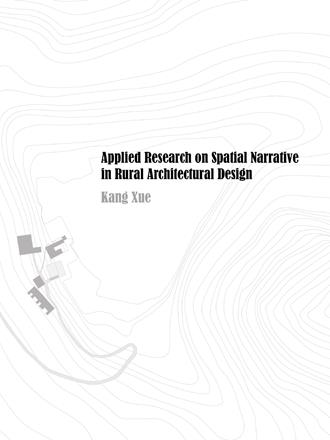
Applied Research on Spatial Narrative in Rural Architectural Design
by
Book Cover & Preview Text
Chapter One Why Revisit Spatial Narrative?
1.1 Research Origins and Problem Awareness
Context of the Times: The Disappearance of Architectural Meaning and the Return to Experience
With the development of economic globalization and the information age, architecture has gradually become a seal of politics, capital and culture, and is increasingly divorced from the spirit of place and life experience of specific regions. Modern spatial production emphasizes material-functional relations while neglecting socio-cultural and emotional relations. However, consumers and users in the information age are more enthusiastic about diversified emotional experiences under the aesthetic vision of daily life. At the same time, the functional paradigm of modern architecture is insufficient to measure or interpret the complex relationships and semantic characteristics of avant-garde architecture. Therefore, the field of architecture constantly seeks new research paradigms from interdisciplinary perspectives and reconsiders architectural creation. From the late twentieth century onward, postmodern philosophy, semiotics, geographical psychology, phenomenology and cultural anthropology were introduced into architecture, and cross-disciplinary research between architecture and narratology gradually emerged.
Academic Context: Narrative Intervention from an Interdisciplinary Perspective
Since the 1960s, with Robert Venturi’s Complexity and Contradiction in Architecture as a landmark starting point, architects began to reflect on the stereotyped and insipid spaces created by modernism in different cultures, regions and ethnic groups, and widely discussed the meaning of space. Works such as Aldo Rossi’s The Architecture of the City, Christopher Alexander’s The Timeless Way of Building, Christian Norberg-Schulz’s Genius Loci: Towards a Phenomenology of Architecture, Kenneth Frampton’s Towards a Critical Regionalism: Six Points for an Architecture of Resistance, and Wang Shu’s Fictionalizing City all focus on spatial meaning from a critical perspective on modernism. Among these theories, spatial narrative, as a multidisciplinary architectural theory, provides a new research direction.
1.2 Rationale for Attention to Rural Architecture
The Universality of Rural Architectural Design
Rural construction is an important part of global modernization and urbanization. Especially in post-industrial society, with economic restructuring and industrial upgrading, the contradiction between urban prosperity and rural decline has become increasingly prominent. The massive migration of rural population to cities not only compresses high-density urban space but also leaves rural space barren and wasted. Whether in Europe or in China, a traditional agricultural country, the reconstruction of rural space is important and urgent in urbanization.
The Lack of Spatial Connotation and Cultural Attributes in Rural Architecture
In contemporary place-making from a global perspective, the conflict between the globalization of free capital and local cultural identity has become a major challenge for many developing countries. In China’s rural construction aimed at promoting urbanization in particular, mechanized and mass-produced design tendencies of modernism have caused rural architecture to lose its cultural attributes and local characteristics. The spirit of place and spatial connotation of rural architecture have therefore become major demands of architectural design.
The Spatial Narrative Potential of Rural Architecture
As an economic form, social form and human settlement space, the countryside is not only a carrier of nostalgia but also a field containing complex issues. In the contemporary era of pervasive capital, the countryside is meaningful narrative material that can be experienced, viewed, played with and consumed. Compared with modern cities, rural space is more regional; it possesses both a critical sense of identity and a unique sense of place experience, providing a feasible object for spatial narrative research.
1.3 Research Object and Scope
This book focuses on the application of spatial narrative in rural architectural design. The research object mainly includes the following aspects: first, theoretical research on narratology in literature, including its concept, development and narrative mechanism, so as to establish the research scope; second, theoretical and practical research on spatial narrative in architecture, analyzing classic theories and cases of spatial narrative and narrative architecture, so as to provide arguments and examples for spatial narrative design methodology; third, research on spatial narrative design methods, analyzing the constituent elements and procedural mechanism of spatial narrative design, so as to provide design tools for rural architectural practice; fourth, project practice of spatial narrative in rural architectural design, analyzing the procedures of spatial narrative in rural architecture and the narrative mechanisms of regionality and culture through cases participated in by the author; fifth, the principles, procedures and significance of spatial narrative in rural architectural design, which are refined and organized in the research conclusion.
This book aims to conduct an in-depth analysis of architectural spatial narrative theory and its development in a complex disciplinary context, and to study spatial narrative as a design methodology for rural architecture. Through applied research on spatial narrative, it re-examines the elements, attributes, structure, cultural semantics and construction strategies of space, enabling users to experience pre-set story situations while generating personal re-creation. Ultimately, it attempts to translate the spatial narrative design of rural architecture into a language system, generating cultural identity in the process of spatial expression.
1.4 Research Significance
Spatial narrative can present different social cultures and the spirit and states of human civilization in history. As an architectural design methodology, its theoretical significance lies in incorporating architecture into the narrative dimension and, through interdisciplinary and theoretical development, expanding the field of architecture and providing new concepts and principles for rural architectural design. Its theoretical significance also lies in emphasizing the relationship between architectural physical space and the spirit of place, the external environment, and the experiencer (people). Through narrative research on rural architectural space, rural architectural design can be understood, analyzed, expressed and innovated more deeply.
Formats

Book Details
About the Book
This book introduces spatial narrative into rural architectural design, constructing a design procedure from spatial script, spatial elements, spatial organization, narrative space to the spiritual realm of space. Taking Stonemason Village in Louna, Guizhou as a case study, it explores how old houses, Tiankeng, stone walls, and nostalgic memories can be transformed into experiential spatial stories. Bridging theory, case studies, and design, it offers architects, planners, and rural culture enthusiasts a regional and contemporary approach to rural place-making.
About the Author
Kang Xue is a Chinese architect and Lecturer at the Sichuan Fine Arts Institute. She holds a PhD in Design from the Central Academy of Fine Arts and a PhD in Architecture from the University of Pécs, Hungary. Her long-term research focuses on spatial narrative, rural architecture, vernacular architecture, and sustainable design. Her writing combines the rational rigor of an architect with the sensitive warmth of a narrator: she is skilled at interweaving spatial narrative theory, field research, design diagrams, and place experience, translating abstract theory into perceptible spatial stories through an interdisciplinary perspective. She pays particular attention to collective memory, the spirit of place, and the inheritance of nostalgia in rural space, striving to seek expression paths for rural architecture that are both regional and contemporary in the context of globalization and urbanization. This writing approach, which gives equal weight to theory, case studies, and design, not only provides methodological references for professional readers in architecture, urban and rural planning, and landscape design, but also appeals to a broad readership concerned with rural culture, local memory, and spatial experience